Friday, July 4, 2008

After Garnaut, the big questions will remain unanswered

This is an extract from an opinion piece republished with permission of the author, David Spratt, and ABC online.

Read the full article here.

David Spratt is the co-author of Climate Code Red: the case for emergency action, published by Scribe in July.

The Garnaut Review's deliberations have been frustrated by an incapacity of the government's computer models to even deal with the sort of emission reductions Garnaut thinks are necessary, an indication of the bureaucratic timewarp in which climate policy in Australia is trapped. And constrained by frustratingly narrow terms of reference, the review has been asked to recommend only an appropriate market-based means of reducing emissions, but not on the broader questions of substance.

Garnaut knows that climate science is demanding emissions reduction much faster than the government appears willing to contemplate, noting "the diabolical nature of the policy challenge", and the "widespread view, based on the science, that the risks of 'dangerous' climate change and the risk of abrupt climate change, are already at unacceptably high levels at this point".

In contrast to Garnaut's acute observations that the issue may be "too hard for rational policy-making in Australia" because "the vested interests surrounding it [are] too numerous and intense, the relevant time-frames too long", the government is caught in a policy fog, unable to find its way out of a bureaucratic framework that is now out of date. The Rudd government's current policy target of a 3-degree rise would destroy the Barrier Reef, the tropical rainforests, cause widespread desertification, a mass extinction, and a sea-level rise of perhaps 25 metres, amongst many impacts. Most worrying, the government seems unaware that this would be the consequence of a 3-degree target.

There is little indication that governments understand what is now being said by the world's leading climate researchers: significant climate "tipping points" have already been crossed, and our world is already at the point of failing to cope. Sir John Holmes, the UN relief coordinator, warned that 12 of the 13 major relief operations in 2007 were climate related, and that this amounted to a climate-change "mega disaster".

Take the Arctic, for example. The north pole has until recently been covered by an area of sea-ice in summer as large as Australia. Now it is disappearing fast, likely to be gone entirely within five years. Scientists' well-founded fear is that rapid heating as a consequence of the sea-ice loss will trigger the unstoppable melting of most or all of the Greenland ice sheet, an event which would raise sea levels by five to seven metres, in as little as a century.

When he was a young man, Jay Zwally hauled coal for work. Now a NASA climate scientist, he told a gathering of fellow climate experts at the end of 2007: "The Arctic is often cited as the canary in the coalmine for climate warming ... and now as a sign of climate warming, the canary has died. It is time to start getting out of the coal mines."

Thursday, July 3, 2008

WIckham Park to host Climate Camp

Camp for Climate Action has announced that the site has now changed to Wickham Park, on the corner of Maitland Road and Albert Streets.

The Gerald reported last week that organisers had decided to select a site after delays from authorities.

Authorities have now allowed the Camp to take place at Wickham Park, from July 10-15.

Further information at http://www.climatecamp.org.au/

Wednesday, July 2, 2008

Puppy rescuer jailed

Yesterday prolific British author and activist Sarah Whitehead was sentenced to two years jail for rescuing a puppy.
The beagle had been kept muzzled in a wooden cage and regularly beaten by its owner before being moved to a safe home by Ms. Whitehead.
The puppy is reportedly living happily in hiding from the police.

Tuesday, July 1, 2008

Mayfield East Public School win National Trust Competition

At a ceremony held on the 30 June at Ervin Gallery Sydney the Mayfield East Public School won the National Trust Schools Competition 2008.

With over 400 entrants including those from private and church schools, this award is quite an outstanding achievement for the children of Class 3/4 P and their teachers Ms Sue Pryor and aide Vicki Robertson.

The annual competition inspires students to celebrate their local heritage, along the theme of ‘Our Place’, and encourages students to explore their suburbs and towns, getting to know the people and places that make them unique.

Mayfield East Public School, who are celebrating their 150th anniversary of the birth of their school, invited local identities to be interviewed. The interviewees were each asked around 10-15 questions relating to the early history of the school and environs including Aboriginal history. Then the children drew their subjects as part of their drawing class. The guests included former student Mrs Vera Deacon and University Archivist Gionni Di Gravio.

The children created a replica of their original school house from the 1850s, and explored historical identities such as the late Daniel F. Cooksey, who reported on some finding of aboriginal artefacts on the site of the school in 1925. The University of Newcastle's website relating to the Cooksey Collection is located here:

http://www.newcastle.edu.au/service/archives/mayfield/dreaming.html


The kids were very excited and chased down the original artefacts held in the Australian Museum and invited Dr Stan Florek to bring them along to their school for 'Show and Tell'.


They even tracked down two of his grandsons and invited one, Mr Ian Cooksey, to speak to them as well, along with a former academic in the French Department, Col Whitehead, who has a great interest in Aboriginal stone implements and had made copies of Cooksey's reports in the 1980s.

The web blog for the school's history is located here:

http://uoncc.wordpress.com/2007/09/28/mayfield-east-public-school-150th-anniversary-2008/

The Gerald congratulates Mayfield East Public School for this great success and in particular the staff and students of Class 3/4P for their great achievement.

Tuesday, June 24, 2008

Link to Convict Settlement – James Fletcher Hospital


Demolition has already begun, with all roofing removed from Reception House, Kirkwood House and some outbuildings behind Reception House, at James Fletcher Hospital. Kirkwood House is a direct and tangible link to the convict-built Parsonage and nearby Anglican Church buildings, while Reception House is significant as a purpose-designed mental health facility which marked an innovation in mental health care. As Kirkwood House was built as a 1880s extension to the 1820s Anglican Parsonage before the Parsonage was demolished
It is thought that some fabric from the Parsonage is incorporated in the structure of Reception House. A full archaeological assessment should be undertaken.
The precinct of James Fletcher Hospital is a significant historic site relating to early European and settlement and convict history, and part of the Hill Heritage Conservation Area.
The site falls within the Archaeology Zoning Plan detailed in the James Fletcher Hospital Conservation Management Plan. The Conservation Management Plan assesses that the site has High Archaeological Potential to discover remains from the 1819-1820 Parsonage and its outbuildings. Such remains might reach the threshold for state significance as items relating to the convict period (pre-1830) are rare in NSW, noting the potential to find remains of high significance. The assessment should include a program of archaeological test excavations and geo-sensing scans.
Any archeological remains should be properly assessed and if possible conserved.
Further, there would be high archaeological potential to find deposits relating to the convict era below the current footprint of Kirkwood House (and Reception House) perhaps evidence of paths or gardens or outbuildings pertaining to the Parsonage - or simply occupational debris such as discarded bottles (altar wine of course), broken ceramics,etc.
If convict-era fabric is discovered, it would be rare in Newcastle. The earliest visible fabric in Newcastle dates from 1839 or 1840 (a single courthouse column in Parnell Place, and the medical superintendent's cottage at James Fletcher.) Sub-surface examples of convict era fabric are also rare with the only known examples limited to footings well beneath the convict lumberyard surface. Examples of convict Newcastle outside the Coal River Precinct would be highly significant and rare. Further, the whole complex sits in a corner of the James Fletcher Hospital Complex (SHR), close to the former Officer's Mess and Barracks, dating from 1839. The site also formed a corner of the Commandant's farm from 1804 to about 1820.

Notwithstanding the failure of Hunter New England Health to incorporate Kirkwood and Reception Houses into the new facility, the potential disturbance of state-significant archaeology should be of great concern.
An Interim Heritage Order is unlikely to be attained because this can only be initiated by Minister Sartor, who intervened in the process to order the demolition.
(Courtesy of the Archives of the Anglican Diocese of Newcastle held in the University of Newcastle Cultural Collections)

Sunday, June 22, 2008

Site announced for Camp for Climate Action

After weeks of stalling from local police and council authorities, the logistics working group of the Camp for Climate Action has announced that the camp will be held on public land on the corner of Mangrove Road and River Road, in Sandgate.

The working group had requested several different sites, and at various stages over the past month, authorities had given and withdrawn permission for all of the proposed sites.

With less than three weeks to go until the site, the working group realised that they could not wait any longer and decided to pick a site and promote it.

Up to 1000 people are expected to participate in the Camp for Climate Action. In late May, the actions working group announced that the highlight of the camp would be a mass blockade of the rail line which delivers coal to the world's biggest coal port.

According to the Gerald's sources, authorities are now tripping over themselves to find a different site for the camp.

The camp was promoted yesterday at a flash mob at Westfield Kotara, where up to 60 people who met each other via the social networking site Facebook froze for five minutes to demand a freeze in the growth of greenhouse gas emissions.

It was also promoted in Parliament by NSW Treasurer Michael Costa on Wednesday and Thursday, in response to questions by Greens MLC John Kaye. The Treasurer misled Parliament into believing that the camp was organised by the NSW Greens in order to divert attention from a question asked by John Kaye. Mr. Kaye asked the Treasurer whether failure to privatise the electricity industry would lead to his resignation, as he promised in early February.

Tuesday, June 3, 2008

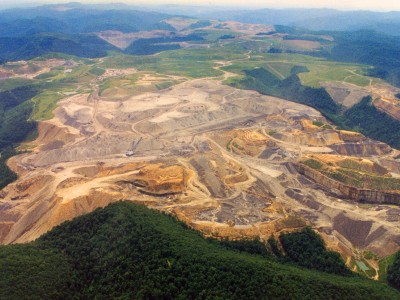
Crude coal mining: Mountain Top Removal


The local Herald run a story 'How mining is taking its toll on the Hunter' last Friday. It reports on a secret NSW Government document which admits that coalmining in the Hunter causes massive environmental damage. The
Government, of course, won't endorse the document.

To mark World Environment Day this Thursday (June 5) Socialist Alliance and Green Left Weekly supporters will screen "Mountain Top Removal".

"Mountain top removal" literally means the removal of the mountain tops to get at the coal below. It is the crudest form of environmental violence. Even after strip mining, some trees might grow back. But you can't grow back
a mountain.

It will be the first screening in Australia of this new documentary from the US. The film won this year's Reel Current award selected and was presented by Al Gore at the Nashville Film Festival.

Screening Thursday June 5
7pm
Resistance Centre
472 Hunter St Newcastle
Info: 49265328 or 0406296141